

Brushstrokes: Writers as Painters
Rejoice: Your September Syllabus Scremes is finally here.

Welcome back to Syllabus Scremes, my monthly thematic recommendation series. This month, books about (in some way or another) painting and painters.
Brushstrokes
Too many writers want to write characters who are writers. As the adage goes, “write what you know.” And many novelists do indeed write novels with characters who are… novelists. It’s an interesting phenomenon. These novels are rarely discussed as meta-projects simply because writing a writer makes sense: the writer-author can easily say what they want to say via the writer-character, revealed in passages of diaristic or work-in-progress style prose.
But there is a shared impulse in (novel) writing and painting. As two of the static arts, they stand apart from the performance arts of dance and theatre and music. Likewise, they are both art forms that are primarily produced alone. (Yes, both writing and art can be collaborative, but that element of the creative process is not essentially built in as it is with dance, theatre, or music.)
A writer’s task is to paint portrait, landscape, and movement all at once, and with language. And both painters and writers ultimately have the constraints of edges. Yes, canvases can reach magnificent propotions (Looking at you Cy). As can books (ahem…Knausgaard). Those edges may not be square (Anish Kapoor) or can be inverted (Catherine Lacey) but even at an oversized scale or irregular form, these two media of art are bounded by an edge.
The authors of the three novels I chose for this month’s syllabus “paint” portraits of their central characters by tapping into that shared impulse between writing and painting, using the language and process of painting to unfurl lives and relationships on the page.
Please enjoy and in the spirit of the “Syllabus” of it all, class discussion is most welcome in the comment section. xx, S.
Mains
Three novels to form the backbone of Brushstrokes.
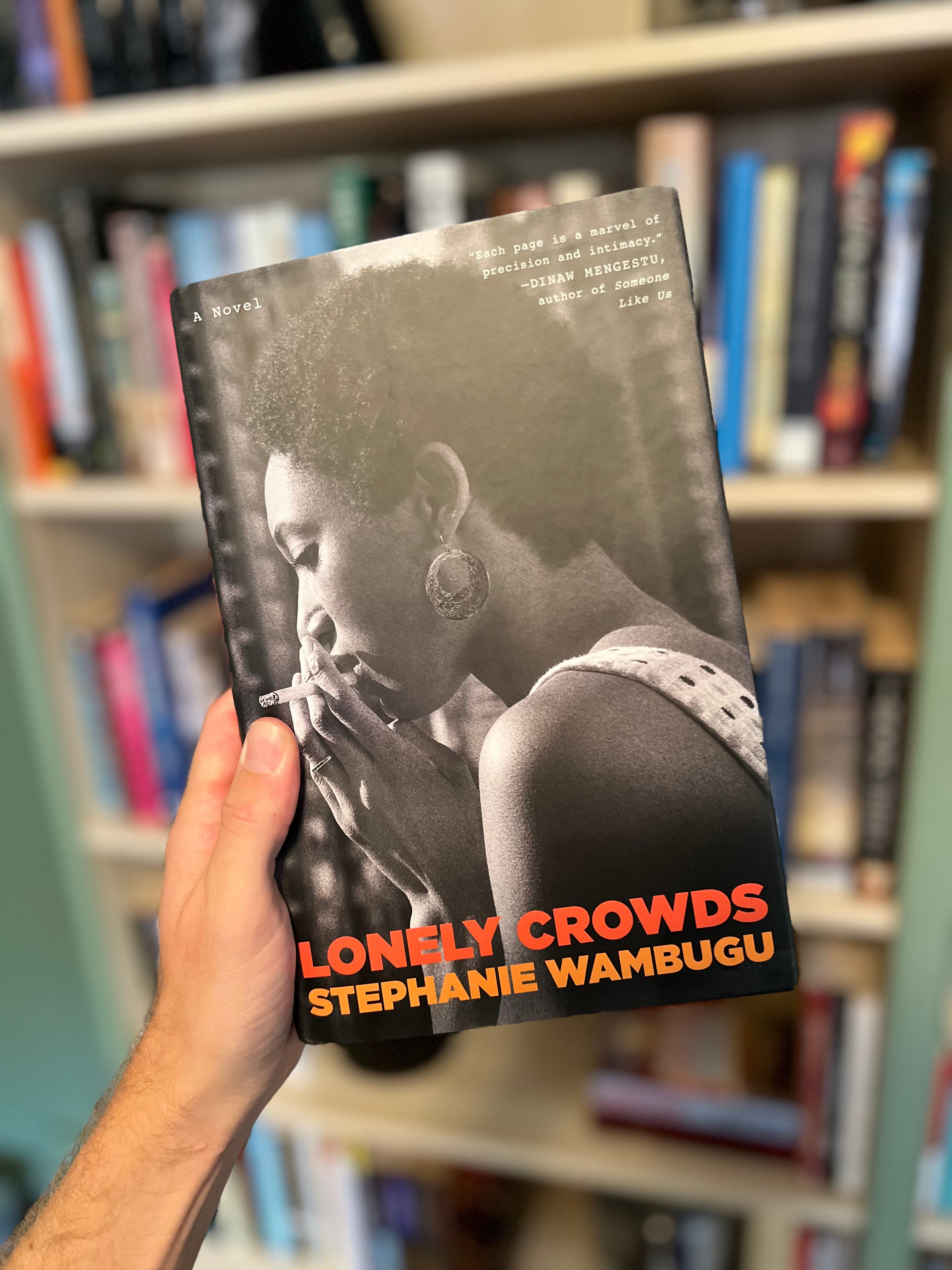
Lonely Crowds (2025) by Stephanie Wambugu
I finished Stephanie Wambugu’s debut novel over the weekend. I begin this month’s syllabus here, as Lonely Crowds is one of my favorite releases so far of the year and prompted my thinking about that impulse shared by writing and painting.
Ruth (our protagonist and narrator) is a painter, but this book is first and foremost a book about the complicated experience of having a soulmate. For Ruth, this is Maria, a childhood friend who comes to encompass many things contained in that simple word, friend. Ruth, whose father gives her a set of paints at a young age (an act that seems to Ruth to have fated her to the artist’s life, describing it as she does ever with a subtle underlying tone of blame) becomes a professional painter. We know this from the very first page, which is set in Ruth’s 30s, before the book leaps far back into memory. Maria is not a painter, but an artist; one who combines video, performance, and perhaps even the foundational act of living, into her practice. Over their childhoods, adolescence, and 20s, we watch as these two struggle to uncover who they are.
Lonely Crowds digs (not gently, but like a fingernail pulling again and again at a scab) at what it means to be an artist and what it means to have a soulmate, a muse. Ruth’s relationship to her art and her relationship to Maria are deeply intertwined: they feed one another and feed upon one another, at times inspiring in both directions, at others vampiric. It is an ultimate bildungsroman, a novel of becoming; one in which we get to see the portrait of the painter—of Ruth—painted again and again and again as she grows up, Maria’s influence impossible to remove from the canvas.
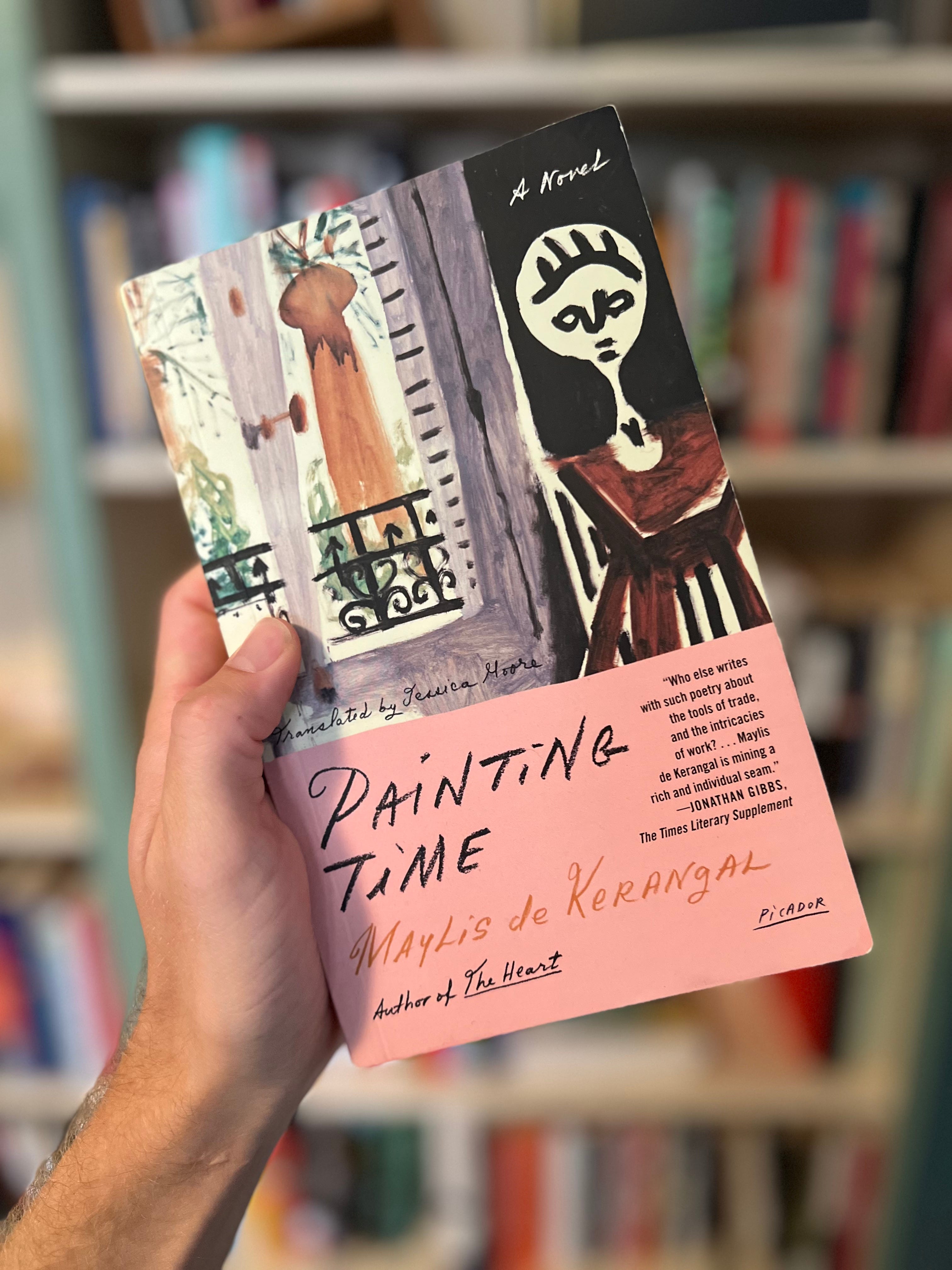
Painting Time (2022) by Maylis de Kerangal, trans. Jessica Moore
In Painting Time, the first of two translated works in this month’s list, Paula Karst studies at “the Institut du Peinture (30 bis, rue du Métal in Brussels) between October 2007 and March 2008” to become a trompe l’œil painter.
Where Lonely Crowds opens with a party that merges into a gallery show for Ruth’s paintings that prompts the beginning of her memories, Painting Time opens with Paula on her way to meet her two companions from her past at the Institut du Peinture, similarly breezing out into the city. The seasons are different, but I’m totally satisfied by the parallels in these opening scenes.
From Painting Time:
Before stepping out into the street she undoes another shirt button—no scarf even though it’s January outside, winter, la bise noire, but she wants to show her skin, wants the breath of night wind against the base of her throat.
From Lonely Crowds:
Maybe I had been acting erratically, since everywhere I went people asked me if I was feeling okay, as you might ask an insane person as you led them back to a shared reality. I started to sweat as I walked, and I took off the blouse I was wearing over my thin dress and put it in my bag. My chest, shoulders, and legs were bare and covered with sweat and I was reminded of a recurring dream I had had for years of walking around the streets of a strange town naked, while everyone pretended not to see me.
Other than this parallel, Paula and Ruth are not terribly similar and de Kerangal and Wambugu’s styles are quite different. Still, both books explore that friendship-collaborator-competitor-muse spectrum as well as that tricky business of becoming—of struggling financially and artistically and of finding the people, the jobs, the cities, the ways of being that make it possible to take the offramp toward a new life.
Maylis de Kerangal is known for her deeply researched novels about singular professions: Naissance d’un pont (Birth of a Bridge) about the building of a bridge in California; Réparer les vivants (The Heart) about cardiac surgeons. Un monde à portée de main (Painting Time) does not disappoint in its detailed habitation of the profession of trompe l’œil painters. You are guaranteed to learn something you didn’t know before!
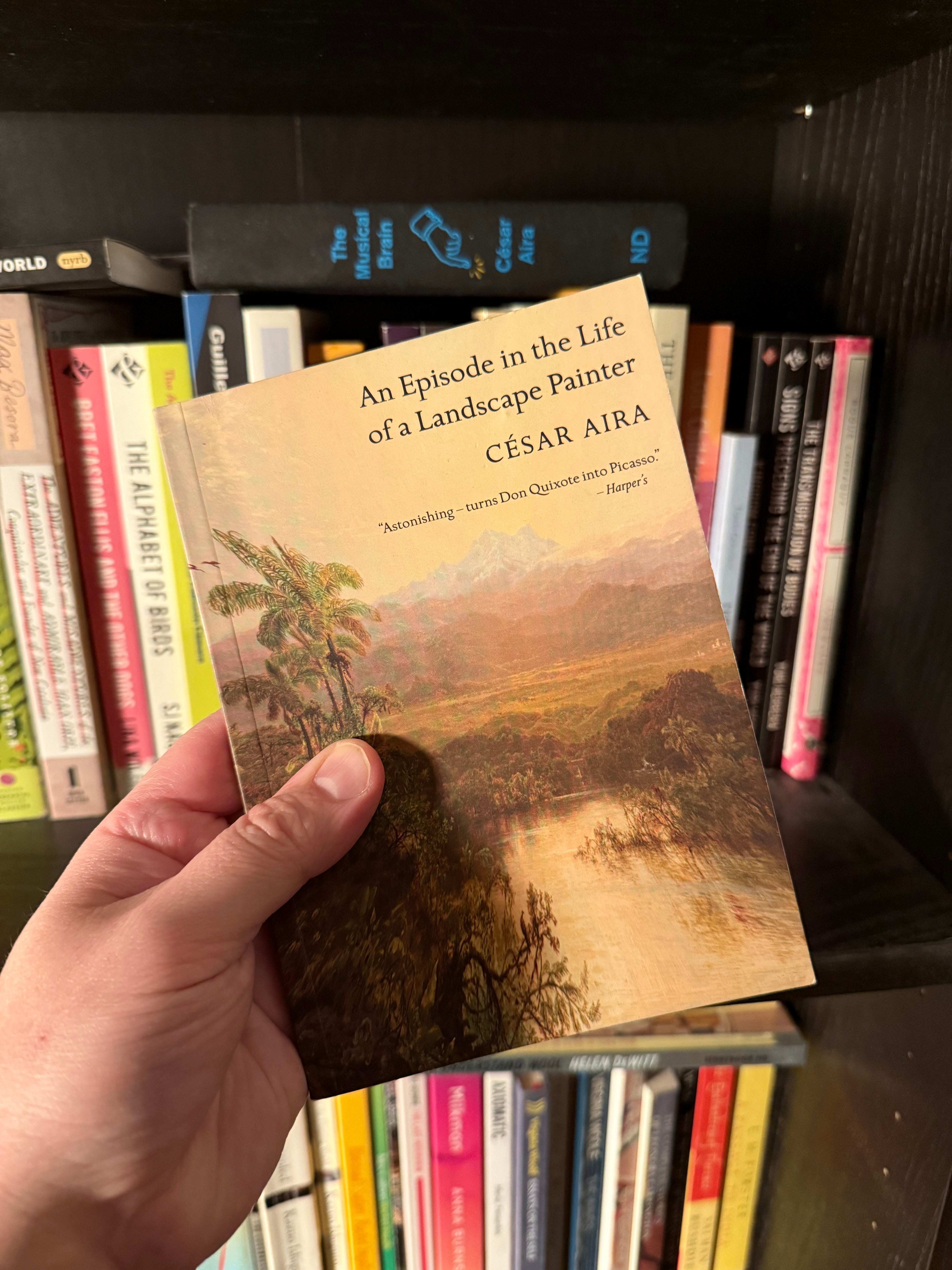
An Episode in the Life of a Landscape Painter (2006) by César Aira, trans. Chris Andrews
This strange, slim book explores the surreality of what happens to vision and perception after brain injury. Set in the first half of the 19th century in Argentina, the novella takes as its protagonist the very real German painter Johann Moritz Rugendas, who was a disciple of the naturalist Alexander von Humboldt and a student of the discipline of “physiognomic totality” in landscape painting: an aim toward total harmony on the canvas, of scientific precision in the rendering of a landscape in miniature.
While travelling across the Pampas from the mountains toward Buenos Aires, Rugendas is struck by lightning and dragged across the plains by his bolting horse. In César Aira’s pen, this event indeed becomes a surreal, terrifying episode. Here, form and content are humming in a literary physiognomic totality. Aira’s concentrated prose serves to oversaturate the narrative, mirroring the hypersensitivity to light and color Rugenda experiences. Very unique, this one!
Pairings
More to read, watch, and look at in the vein of writers-as-painters.
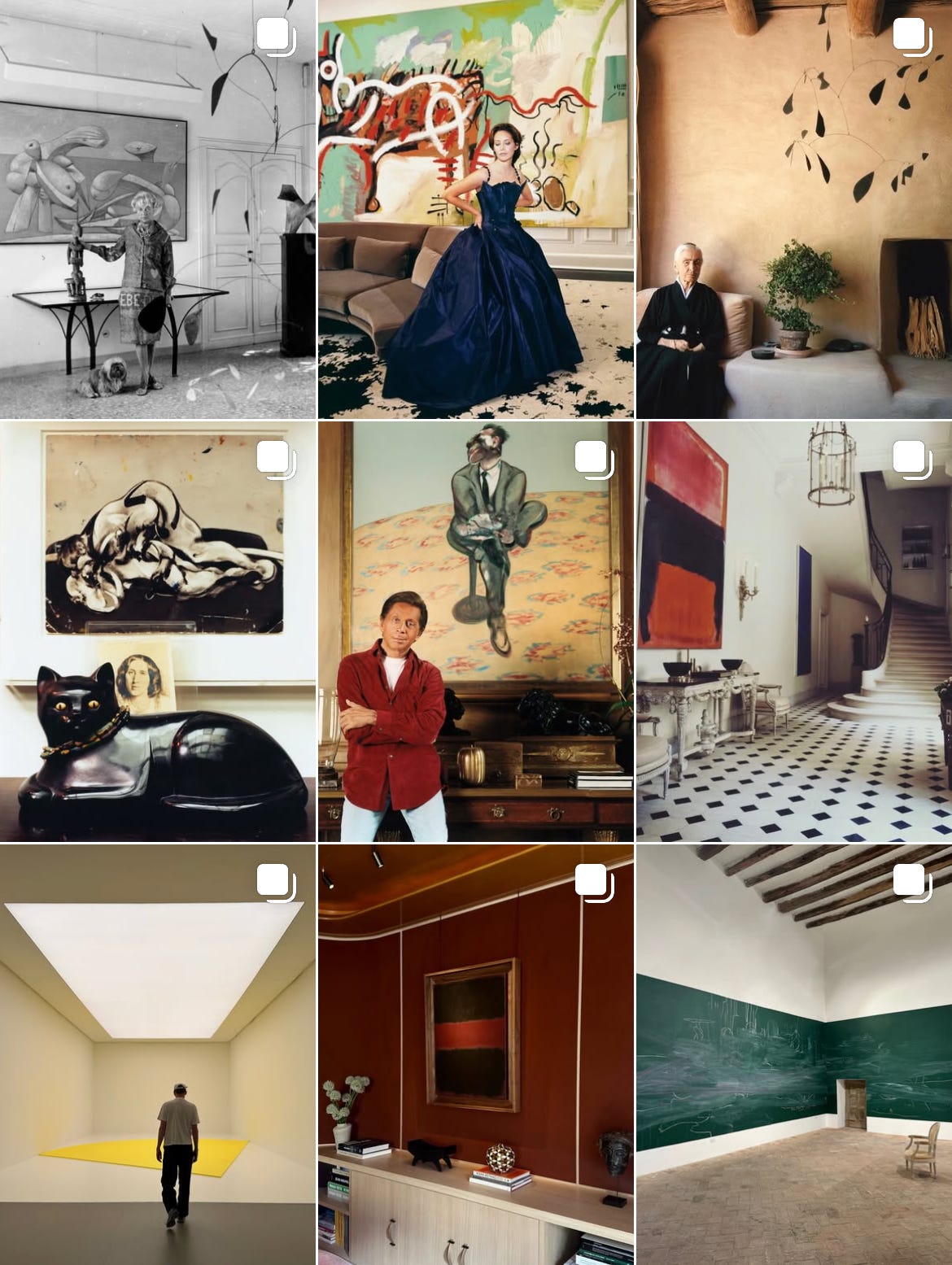
“How Painters Capture Literary Legends” in Sotheby’s (2025) by Lucas Oliver Mill
The voice behind the Instagram account collectorwalls, Lucas Oliver Mill’s obsession with the specific ways that great art collectors live with their art has earned him a dedicated following.
In this very brief essay for Sotheby’s, Mill writes:
“In many ways, the wordsmith has the upper hand: the written medium is an unlimited resource, allowing them to flesh out their characters with as much complexity as they wish. The painter, by contrast, has just a single frame to leave an enduring impression.”
It’s worth clicking through the protraits. One gets a sense of the aethetic relationship between painter and sitter — here, a mutually derived vision; there, a tension between artist and writer simmering to the visual surface.
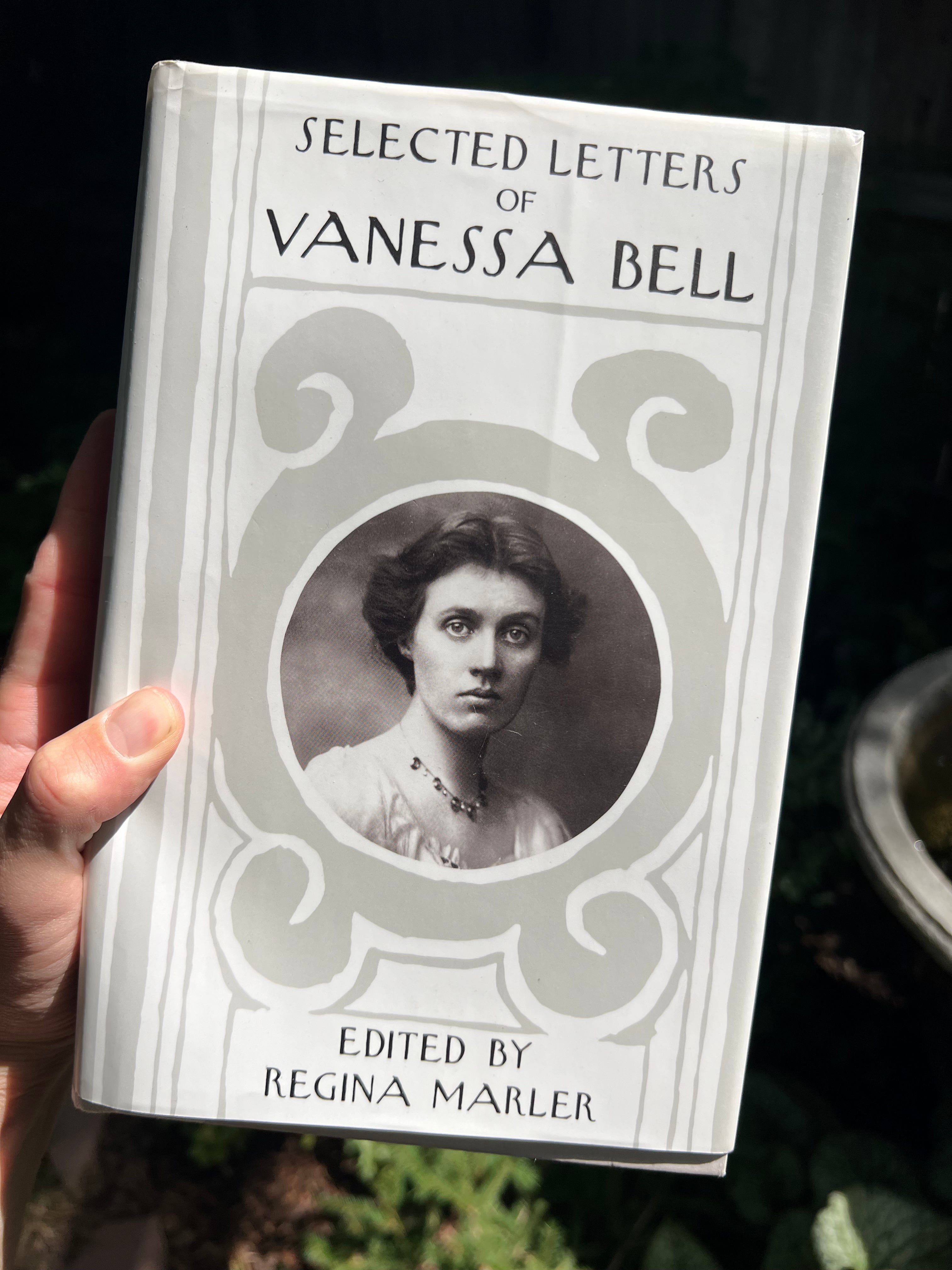
Selected Letters of Vanessa Bell, (1993) ed. Regina Marler
Vanessa Bell was a modernist painter, member of the London Group, and sister (of course) to Virginia Woolf. She was the lover of the painter Duncan Grant, deeply connected to art critic Roger Fry, visited Picasso and Gertrude Stein when she travelled to Paris, and was the beating heart of Bloomsbury.
Though Virginia Woolf is the Stephens sister known for her sparkling command of the English language (a talent Vanessa often remarked upon, deprecating her own use of the pen), Vanessa Bell’s letters are extraordinarily vibrant and regularly crack me up. Her gossipy tone and wry humor, subtly and lovingly digging at herself, her recipient, and their friends, give wings to her letters.
There’s much to devour of Vanessa’s thoughts on painting in these letters. One also finds a very painterly interpretation of literature in them. Of her sister’s novel To the Lighthouse, which featured characters inspired by their parents as well as Lily Briscoe, a painter who becomes the central character, Vanessa wrote, “So you see as far as portrait painting goes, you seem to me to be a supreme artist…”1
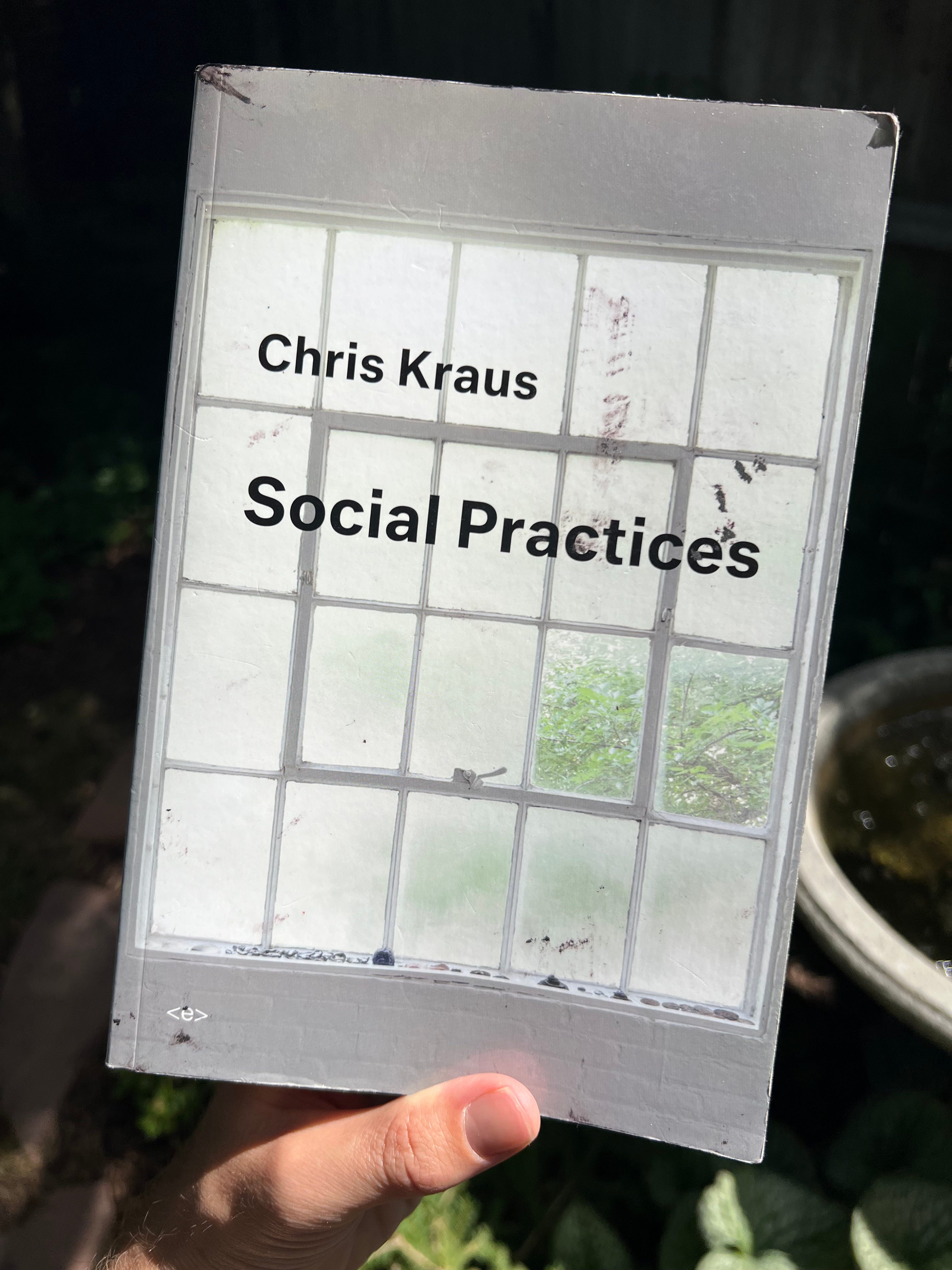
Social Practices (2018) by Chris Kraus
Chris Kraus is one of the greatest gifts to American art criticism. She has been a fixture at the intersection of literature and the visual arts since the ‘90s, when she proposed the influential “Native Agents” imprint at Semiotext(e), the press founded by her former husband, the French cultural critic Sylvère Lotringer. The imprint promoted works by American writers—mostly women and queer—and was designed to promote an anti-memoiristic “public I”.
Social Practices brings together Kraus’ essays from magazines, exhibition catalogs, and some unfinished works written between 2005 and 2018. Essential reading for anyone interested in understanding this critical period in American contemporary art—especially diasporic art outside of New York—to contextualize the art landscape today.
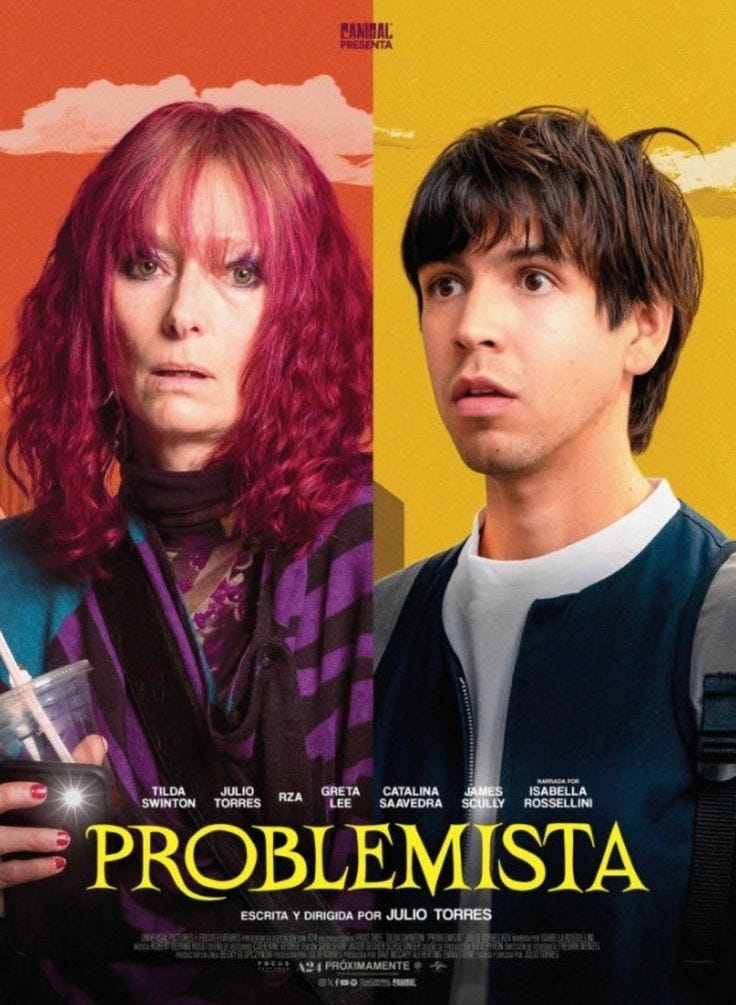
Problemista dir. Julio Torres (2023)
Streaming on Max
I saw Problemista with Hanna at Angelika when it came out and was immediately taken by it. It seems these days to be a rare treat to see an artist’s creative vision come through so strongly in a film. Julio Torres’ directorial debut felt uncompromising in its style and storytelling.
Alejandro (Julio Torres) is a young Salvadorean artist who wants to make toys. He’s in the US on a visa, but when he gets fired from his job at a cryogenics lab, he has 30 days to find a new visa sponsor, or he’s at risk of deportation. Enter Elizabeth (Tilda Swinton), whose late husband, Bobby Ascensio (RZA), was an artist who had been cryogenically frozen and was under Alejandro’s stewardship until his firing. Elizabeth is an eccentric, a New Yorker of a somewhat bygone art world, who dreams of mounting a solo show for Bobby’s paintings of eggs. If Alejandro helps her, she will sponsor his visa.
The film is surrealist and, as is the case with the best of surrealism, taps into the very real and very nuanced relationship between people like Alejandro (Julio Torres) and Elizabeth (Tilda Swinton) — that balance between precarity and power, youth and age, emerging and established that yields more than it is often given credit for. There is a give-and-take in these relationships. They are not purely transactional, not unidirectionally exploitative. Like Lonely Crowds, Problemista is a love story.
Selected Letters of Vanessa Bell, (1993) ed. Regina Marler. 317.
Incredible curation!!