

Get Wet! (March Syllabus)
I bring you a Very Piscean Reading List for your next Syllabus Scremes

Hello Scremesters! Welcome back to Syllabus Scremes, my monthly thematic recommendation series. Now that we’re squarely in Pisces Season, I leaned into my identity as a super-stellium Pisces (It’s my Sun, Moon, Mercury, Mars, and Saturn) this month and put together a Syllabus for you inspired by one of the more famous (and entirely true) Pisces associations — our obsession with water. Enjoy!
Get Wet!: A Piscean Syllabus
The following books and movies revolve around some body of water — a pool, a beach, a pond — and share an element of darkness. Water is a bearer of ultimate duality; it is essential for life, but it can also kill you in any number of ways. Languorous summer days by the pool, haunted by the specter of infidelity; a yacht on the Mediterranean with a murderous conman; the jagged rocks hidden below the water under a bridge; a too-hot bath… the possibilities of water-related pleasure and disaster are obvious and also forever tantalizing.
As I selected these novels and films, which drift from bucolic dreaminess to terrifying nightmare, I realized that in a way, I was assembling a syllabus that forms one vector of my personal canon as a writer. Let’s get into it.

The Talented Mr. Ripley (1955) by Patricia Highsmith
In 1950s Mongibello, Italy — a fictional stand-in for any number of Amalfi coast towns — the summer of dolce far niente for expat upper class American layabouts Dickie Greenleaf and Marge Sherwood is turned on its head with the arrival of genius (and sociopathic) forger, impressionist, and con-man Tom Ripley.
Only the first of Highsmith’s so-called ‘Ripliad’ — followed by Ripley Under Ground (1970), Ripley’s Game (1974), The Boy Who Followed Ripley (1980), and Ripley Under Water (1991) — The Talented Mr. Ripley is a centerpiece of the water-as-danger canon.
Highsmith’s fourth published book, Ripley swiftly became her most famous. Her notebooks, which Highsmith’s editor Anna von Planta discovered literally in the back of a closet more than two decades after Highsmith’s death, were gathered and published in 2021. In an early diary from 1950 (the year Strangers on a Train, her first novel, was published), she records an insight into her mind as a writer:
Suddenly the writing of novels has become a little game…the main object is to please and to entertain and condense one’s material, that the finished product is but a tiny fragment broken off of the great mass of material, and polished to the highest degree.
If Ripley is a tiny fragment broken off from the great mass of Highsmith’s material, it is a tantalizingly shiny fragment that draws the eye and mind back to it over and over.
Pair with:
The Talented Mr. Ripley dir. Anthony Minghella (1999)
All of the performances in Minghella’s adaptation of the novel are spectacular, but none quite so much as Philip Seymour Hoffman’s Freddie Miles, the Jazz-loving, fast-driving American playboy. The scene when Freddie pulls up in his cherry-red Alfa Romeo in front of the Trevi Fountain is a delicious bit of acting from one of the great masters of the craft.

Plein Soleil dir. René Clément (1960)
Before Matt Damon took on the role of Tom Ripley, the cunning forger and chameleon was played by Alain Delon. Whereas Minghella paces out the suspense of the story in beautiful, classical fashion, Clément assembles a far stranger type of off-putting terror, using the elements of cinema, of the lens and the frame especially, to set our teeth on edge.
Perfume & Pain by Anna Dorn (2024)
Though this book is not exactly Piscean on its own, the point of these syllabi is to thread together readings and Anna Dorn’s stand-out novel of last spring is the ultimate in Patricia Highsmith fangirling. Here’s narrator Astrid on her self-destructive best friend:
For most of my twenties and early thirties, I got by with the help of a magic cocktail I came to call “the Patricia Highsmith.” Alcohol, sativa, Adderall, cigarettes. On the Patricia Highsmith, I could do anything. I published three books, optioned two. I had an active social life; some even called me a “party girl.” I dated half of Los Angeles, fell in love more times than any one person has a right to in a lifetime.
Loving Highsmith dir. Eva Vitija (2022)
Film Forum premiered this documentary of Highsmith alongside a series of her other film-adapted novels. I include it in the syllabus for completeness, but the documentary itself falls rather flat, which is a shame since Highsmith lived a truly wild life.
From Rockaway by Jill Eisenstadt (1985)
Jill Eisenstadt’s 1985 debut opens on its teenage working class cast rollicking toward their hometown of Rockaway, Queens in a limo in the witching hours after senior prom. The characters reappear in solos, duets, and triads throughout the following fourteen chapters, some whiling away long hours as lifeguards during the summer, another paying for the party away at a New England liberal arts college, being pulled inexorably back, one way or another, to the beach, to the Rockaway that raised them.
And ever flowing through the slim, beautifully paced novel is that horror-allure of water that forms the core of this syllabus.
Pair with:
Beach Rats dir. Eliza Hittman (2017)
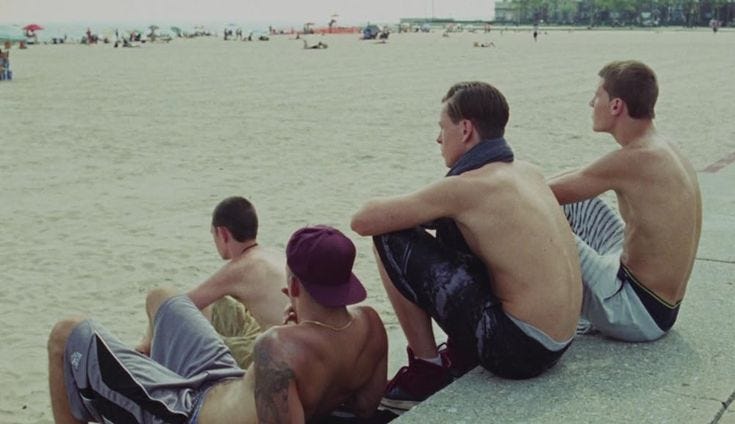
Before Babygirl, Harris Dickinson’s performance as Frankie was the first thing that drew me to him. While there are distinctions certainly to be made between the film’s setting of Gerritsen Beach, Brooklyn and Rockaway Beach, Queens, the parallels between the aimless and delinquent boys populating Beach Rats and those populating From Rockaway is unmistakable.
Invincible dir. Vincent René-Lortie (2022)
I also see a lot of the anger and ennui and daring in the character of Marc in this Oscar-nominated Quebecois short that I do in the boys who populated From Rockaway. Plus, you can watch it now on Vimeo!
Sundays with Scremes feat. Jill Eisenstadt, forthcoming!
I’m very excited to share a conversation with Jill Eisenstadt very soon with you all. If you’re not subscribed yet, you won’t want to miss this.
As an interlude, I suggest a pair of two very aquatic movies that don’t have literary counterparts but are so very much a part of this canon that I can’t not include them.
La Piscine dir. Jacques Deray (1969)
You should follow up Plein Soleil with another Alain Delon banger. I won’t claim expertise on Delon’s career, but I have found that I like him best in somewhat dastardly roles, where he’s on the edge in some way. This film delivers that beautifully.
In an otherwise scathing review of the film after its rerelease at Film Forum and induction to the Criterion Collection in 2021, New Yorker critic Richard Brody somewhat unwittingly goes directly to the heart of the film’s central fascination for this syllabus:
The real stars of “La Piscine” are inanimate—the sharp-edged and inviting pool itself, the sumptuous villa and its splendid landscape, several pieces of eye-catching high-design furniture, the protagonists’ snappy and elegant clothing by André Courrèges, the green of a towel and the yellow of lawn furniture, Harry’s red high-horsepower Maserati.
Visually, there is a sort of advertisement quality to Plein Soleil, which I actually think that serves the film well by underscoring the cruel glossy edge of desire.
Beau Travail dir. Claire Denis (1999)
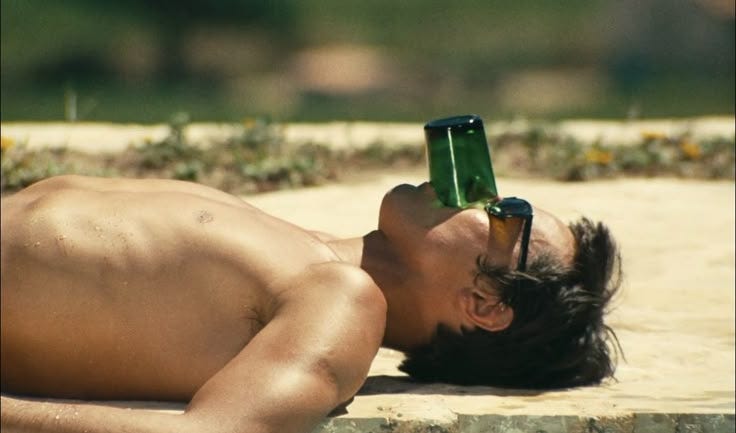
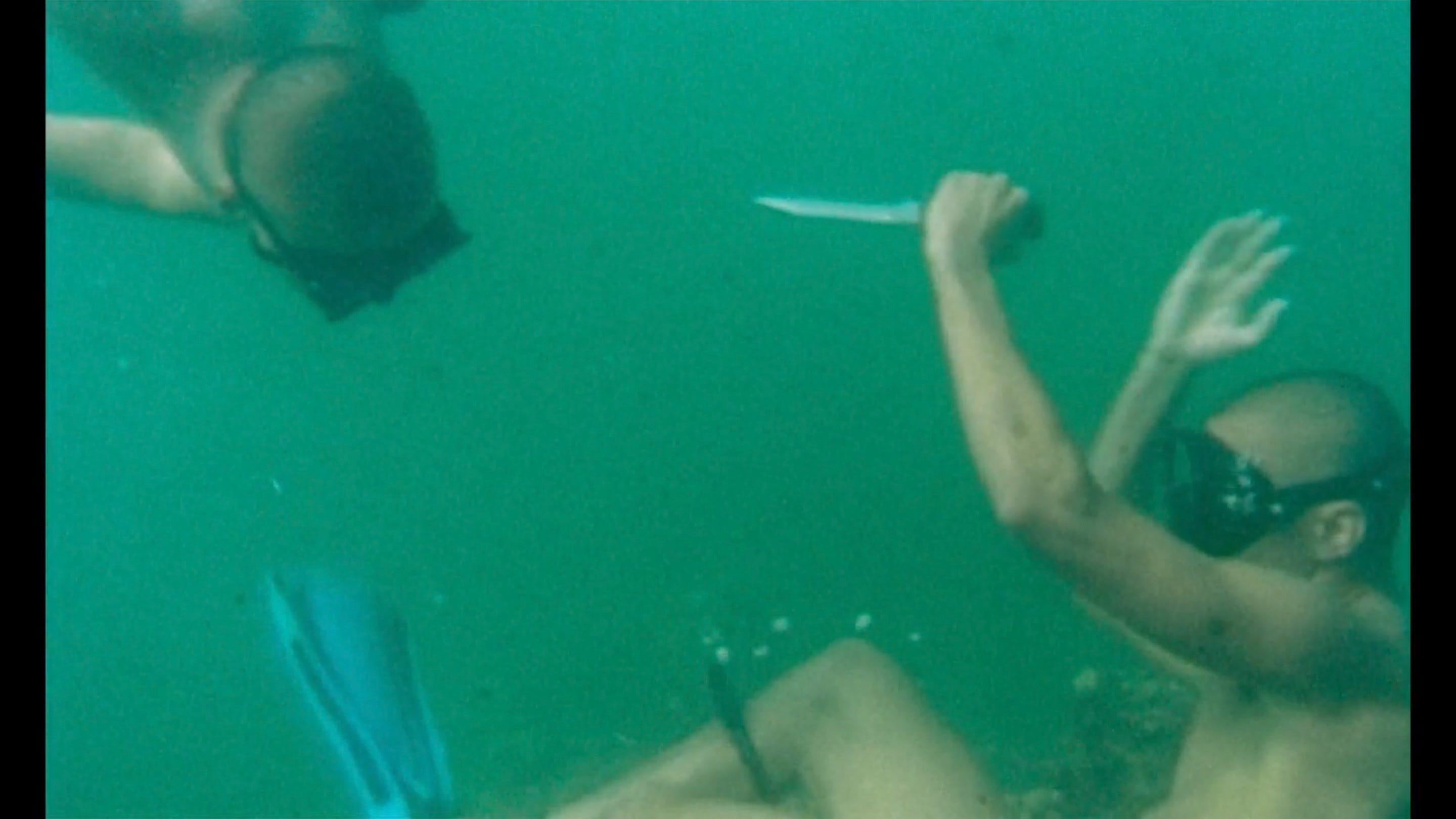
Another watery, dreamy, envy-fueled film, Claire Denis’ magnum opus traces the daily mundanity and sublimity of life for a troop of the French Foreign Legion in Algeria. This is no war movie and in fact barely a military movie. It’s a slow burn of a Piscean film that lingers in the narrow channel between permissiveness and restriction.
Plus, it’s simply one of the most beautiful films of all time.

Pond by Claire-Louise Bennett (2016)
I close this month’s syllabus with my favorite collection of short stories of all time. Written over the course of a year living on the Irish coast, the stories in Pond (Claire-Louise Bennett’s debut) are all delivered from the same narrator’s first-person point-of-view, as she hosts a party and takes a bath and gets the mail and cleans out the shed at her rented cottage with a pond out the back.
While it is decidedly a collection and not a novel of vignettes, the stories link one to the other, allowing the reader to move through the novel as if through a summer pond, now breast stroking off from the dock, now floating on one’s back on the warm upper strata, now plunging through the sunlight-streaked browny green into the reeds.
Pair with:
“The Mind in Solitude: An Interview with Claire-Louise Bennett” by Philip Maughan in The Paris Review (2016)
Simply reading this interview will give you a glimpse into Bennett’s prose style. Here, as in the stories, her approach to forming an idea is deliberate and cool-headed, the employment of her language terribly precise. For instance, here’s her response to the seemingly simple question, ‘where are you?’:
I’m in an apartment. And since I pay the rent on it each month and have a key to its door and the codes for the two entrance gates it’s reasonable to say it’s my apartment. I don’t feel much for it though. It seems thin, insubstantial, and often when I sit at the table, to eat, and at the desk, to write, I have the sensation the furniture and me are going to fall right through the floor into the thin, insubstantial, flat beneath. It’s raining, of course it is, it’s always raining. My dapper striped deckchair is swollen stiff with rainwater and will probably never close now. I can’t think why I ever opened it here, on a balcony on the west coast of Ireland.


Now, I hear you saying, “scremes scremes scremes, what about The White Lotus?” Well yes, of course Lotus is a Piscean enterprise. In fact, I had to look up Mike White’s sign (he’s a Cancer, so the water is there). I can almost guarantee you White has read and watched most every entry on this syllabus. If you do too, maybe you can create the next most popular show on TV.
xoxo, Scremes
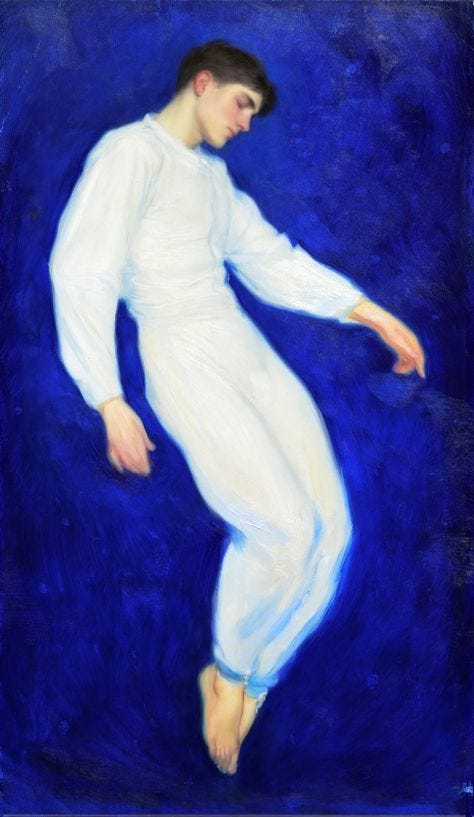
beach rats <3
i feel like alain delon should be a pisces